
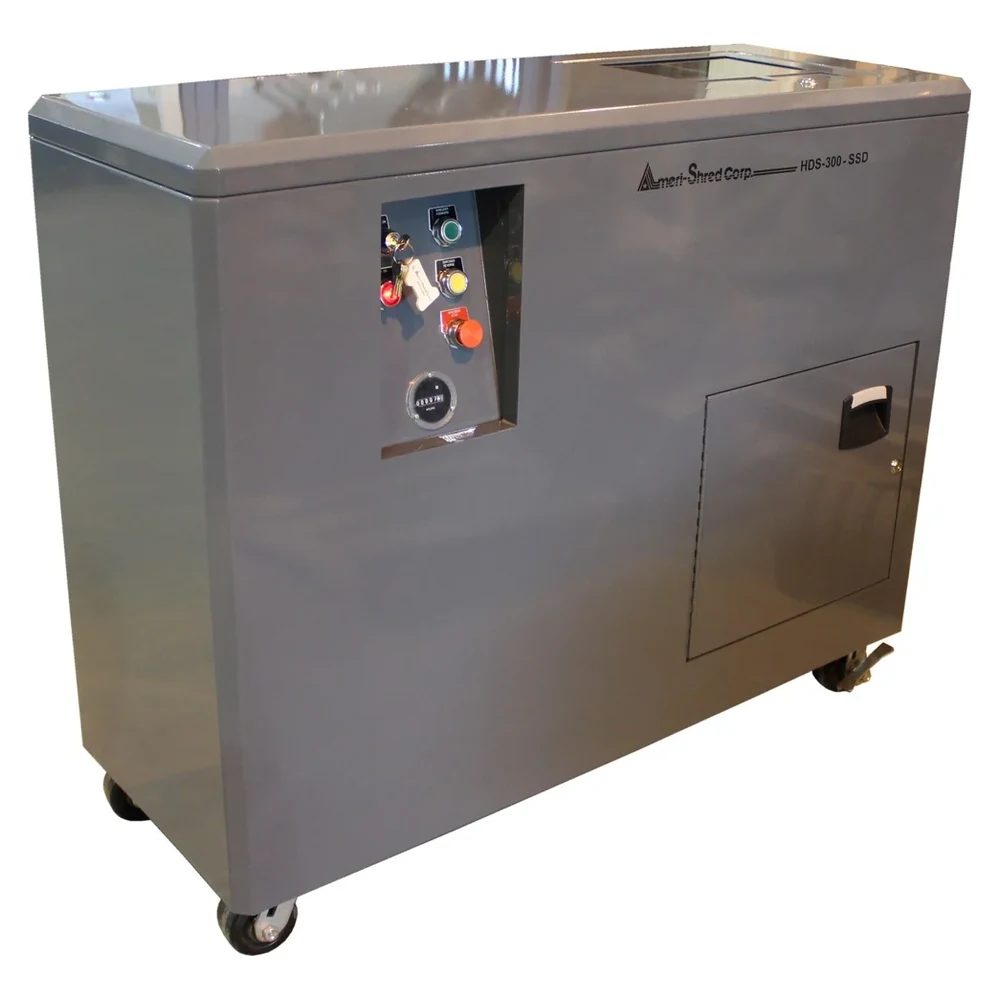
AmeriShred Series 1 HDD and SSD shredder
Bench-top shredder with two independent chambers: one for SSDs, cutting at 9.5 mm, and one for HDDs, cutting at 38 mm or 19 mm. A 1.5 or 3 HP motor and a declared capacity of 180 to 600 drives per hour, depending on model and drive type.
- Two independent chambers: SSDs at 9.5 mm and HDDs at 38 or 19 mm
- Physical destruction of the media, which is what supports a disposal report
- Also processes backup tapes, DVDs, mobile phones and small electronics
- 1.5 or 3 HP, bench-top, with bin or conveyor discharge
- Manufacturer's original data sheet available for download
Deleting the file does not delete the data. On HDDs and SSDs, what prevents later reading is the physical destruction of the media — which is why companies handling third-party data keep shredding on their own site, under their own control and records. The AmeriShred Series 1 was designed for that routine: it takes less than 1.4 m of length, has a 127 × 51 mm (5″ × 2″) feed opening and reduces the drive to fragments by shearing.
The HD-SSD model has two chambers: one cutting at 9.5 mm (3/8″) for SSDs and USB sticks, and another cutting at 38 mm (1.5″) or 19 mm (3/4″) for HDDs. The chambers work one at a time and must empty before the next piece goes in. The SSD-only versions (AMS-150-SSD and AMS-300-SSD) have a single chamber and make sense when the operation does not handle HDDs.
The manufacturer publishes capacity in units per hour, not in kilos. A 3.5″ server HDD weighs more and goes through more slowly than a 2.5″ SSD, which is why the range runs from 180 to 600 drives/h and drops to about half when the cut is 19 mm and the piece is a server drive. To size your routine, count pieces per day and effective operating hours, not the peak of a single hour.
Two operating rules come from the manufacturer itself. First: remove the battery before shredding any device, because a lithium battery inside the machine is a fire risk. Second: on the AMS-150, remove the rails from server HDDs before feeding them. An SSD should not go into the HDD chamber nor an HDD into the SSD chamber — the first is not fully destroyed and the second overloads the cutting assembly.
The machine is manufactured by AmeriShred in the United States and is part of the portfolio Recmax supplies in Brazil, with installation guidance and technical support. The manufacturer's original data sheet is available for download on this page and is the reference for the proposal.
AmeriShred Series 1 data sheet — HDD and SSD (PDF, English)
Official technical data
- Feed opening
- 127 × 51 mm (5″ × 2″)
- SSD cut
- 9.5 mm (3/8″)
- HDD cut
- 38 mm (1.5″) or 19 mm (3/4″), depending on model
- Motor
- 1.5 HP (AMS-150) or 3 HP (AMS-300), TEFC
- Power supply
- 120/208/230/460 V, single or three phase; AMS-300 three phase only
- Dimensions (L × W × H)
- 1.35 × 0.53 × 1.12 m (53″ × 21″ × 44″)
- Weight
- 635 kg on HD-SSD models; 499 kg on SSD-only models
- Discharge
- Bin or conveyor
- Manufacturing
- AmeriShred (USA)
| Model | Motor | SSDs per hour | Standard HDDs per hour | Server HDDs per hour | HDD cut |
|---|---|---|---|---|---|
| AMS-150HD-SSD | 1.5 HP | 180–200 | 180–200 | 90–100 | 38 mm (1.5″) |
| AMS-150HD-SSD | 1.5 HP | 180–200 | 90–100 | 45–50 | 19 mm (3/4″) |
| AMS-300HD-SSD | 3 HP | 550–600 | 550–600 | 275–300 | 38 mm (1.5″) |
| AMS-300HD-SSD | 3 HP | 550–600 | 275–300 | 135–150 | 19 mm (3/4″) |
| AMS-150-SSD (SSD only) | 1.5 HP | 180–200 | — | — | — |
| AMS-300-SSD (SSD only) | 3 HP | 550–600 | — | — | — |
Frequently asked questions
Does physically destroying the HDD comply with the LGPD?
The LGPD (Brazilian Law 13,709/2018) requires secure elimination of personal data once the purpose ends. Physical destruction of the media is one recognised way of doing that, but the classification depends on the type of data, the contract with the client and your company's security policy. What auditors and clients ask for is the record: what was destroyed, when, in what quantity and under whose responsibility.
Can I shred SSDs and HDDs in the same chamber?
No. In the HDD chamber the cut is 38 or 19 mm, too coarse to fully destroy an SSD memory chip. The other way round, an HDD in the SSD chamber overloads the knives and the cutting assembly. Each chamber exists for one type of piece.
Do I need to remove the battery before shredding?
Yes. A lithium battery inside the cutting chamber is a fire risk, and the manufacturer itself advises removing it before feeding. This applies to laptops, phones and any device with an internal battery. On the AMS-150, server HDD rails must also be removed beforehand.
Why is capacity given in drives per hour instead of kg/h?
Because the piece, not the weight, defines throughput. A 3.5″ server HDD weighs more and goes through more slowly than a 2.5″ SSD. The manufacturer's table separates SSDs, standard HDDs and server HDDs for exactly that reason, and the difference between a 38 mm and a 19 mm cut halves the figure.
Related products
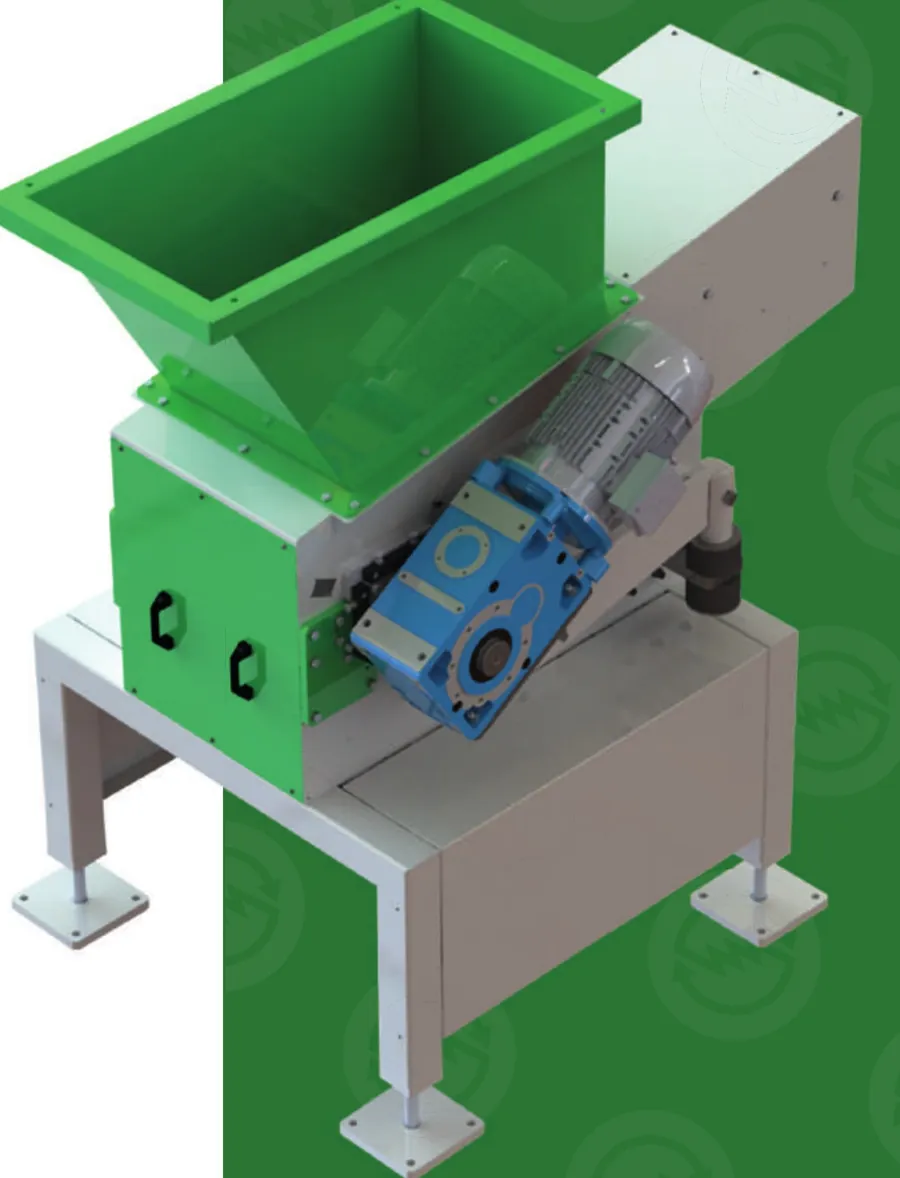
TR300–TR1200
Four models, from 5.5 kW to 45 kW, that reduce thick cable and bulky material ahead of the mill. They couple to the Compact, Turbo and Multiflex Turbo Zig-Zag series.
See details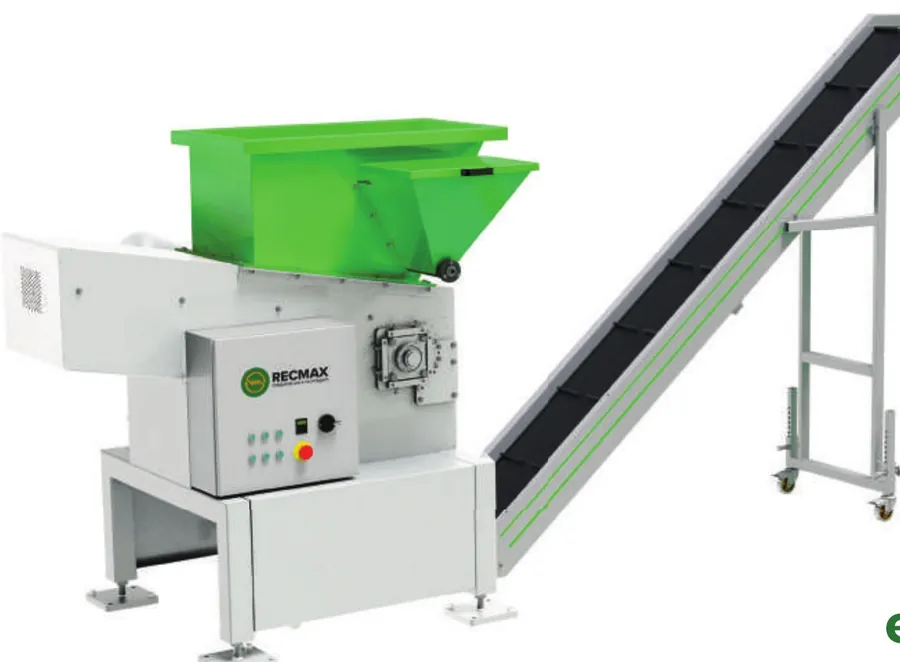
Custom lines
Lines from 200 to 3,000 kg/h for large volumes of copper, aluminium and copper-aluminium radiators, built around your material.
See details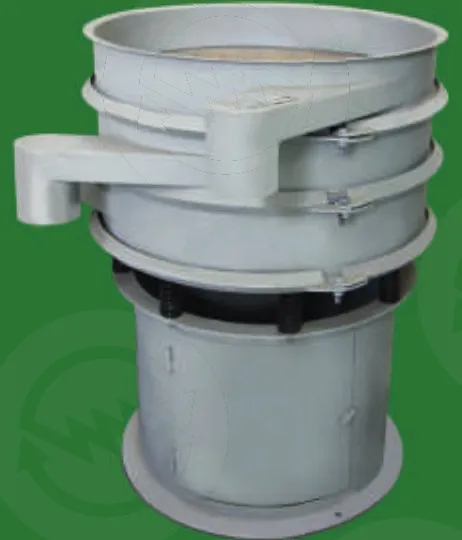
Accessories
The peripherals that remove iron from the line, recover metal dust and control airborne dust. They decide how much metal leaves as saleable product and how much goes out with the plastic.
See detailsTell us how many drives your operation handles per month
With your monthly volume, drive type and operating hours, engineering indicates the model, the right cut and the expected throughput per hour.